Expresso Bongo
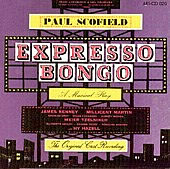
a musical in two acts taken from a story by Wolf Mankowitz. Book by Wolf Mankowitz and Julian More. Lyrics by Julian More, Monty Norman and David Heneker. Music by David Heneker and Monty Norman.
Theatre Royal, Nottingham - 24 March, 1958
Saville Theatre 23 April, 1959 (316 perfs)
Story:
Agent Johnnie discovers Herbert Rudge playing bongo drums in a coffee bar in Soho and signs him to a management contract. Renamed 'Bongo' Herbert and fitted out with a loud, rhythmic song called 'Expresso Party', the boy quickly becomes a fashionable success. The first act charts the new star's way to the top in a gritty, even vehement fashion singing 'Expresso Party' in coffee bars, then on television and record, and finally coming out with a new song when, his identification with youth, sex and violence established, Johnnie plans to widen his appeal with a 'mother' song. The act ends with Bongo in a white suit singing 'The Shrine on the Second Floor' to an adoring audience. On the way up the ladder of success, a cavalcade of Soho characters pass by Johnnie and Bongo: Maisie, the little stripper who longs to be a singer and who can bring out the kinder side of Johnnie; Mayer, the pop recording man who hates modern music and yearns for Aïda; K. Arnold Katz ('Kakky') once a Hollywood producer and now a vagrant trying to set up one more deal; Bongo's sodden father and sour, untrusting mother: all of them used by Johnnie - and the even more unscrupulous Bongo - on their way to the 'big time'.
In the second act Bongo moves out of Soho and into more moneyed waters. At the Diplomatique Club his presence causes a riot and also gets him noticed by the actress Dixie Collins and her wealthy friends. But while Johnnie is busy moving the whole venture onto a classier level, Bongo is slipping from his fingers. He begins mixing with Dixie's society friends, and finally breaks a contract Johnnie has set up in order to fly off to Majorca with the actress. Johnnie cannot persuade him to return and ultimately hears that the boy has broken their management contract. Dixie, it seems, has arranged for him to be represented by a more 'establishment' agent. Johnnie is back where he started. But he will bounce back. In a final tableau he is pushing his new protégée, Maisie, on the road to hopeful stardom as Bongo abandons Dixie for another step upwards in his career.
Expresso Bongo is a hard-hitting, toothy, satirical story of the 1950s, written with skill and a feeling for both its time and its place. Its authors knew well both the East End and Soho backgrounds of which they were writing and the music world in which much of their story was set.
Cast of characters
|
|
|
Musical Numbers:
Don't Sell Me Down the River
Expresso Party
Nausea
Spoil the Child
Seriously
I Never Had It So Good
There's Nothing Wrong With British Youth Today
The Shrine on the Second Floor
He's Got Something For the Public
I Am
Nothing Is For Nothing
We Bought It
Time
The Gravy Train
Discography:
Expresso Bongo OLC - AEI CD-020