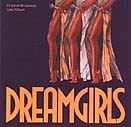
 Dreamgirls
Music by Henry Krieger; Book and Lyrics by Tom Even
Imperial Theatre, Broadway - 20 December, 1981 (1522 perfs)
Synopsis
Dreamgirls is the story of three black singers - Deena, Lorrell, and Effie who began as a group called the Dreamettes. They start as three talented, close friends and gradually sharpen their act and rename themselves "The Dreams". Little do they know of the hard, competitive world of show business.
They enter a talent show held in New York's Apollo Theatre. Disappointed in their failure to win the contest, they attract the attention of a sly tongued talent agent named Curtis Taylor, Jr. Curtis' connections get the girls hired as a backup act to James Thunder Early, a rising pop singing star. They go on tour and are widely acclaimed. At first Curtis falls in love with Effie, the full-figured lead singer who seems to spark the act. Later, in an attempt to make the act more sultry, he moves Deena into Effie's lead spot. But when Curtis' love interest also switches to Deena, Effie erupts in a rage, prompted more by hurt than the loss of her singing slot, and announces that she is not going along anymore. Michelle replaces Effie, and the Dreams go on to achieve international stardom and a string of chart-topping hits.
But life on top is rocky. Lorrell has long since taken up with James Early, but he is married and refuses to make the break from his wife. His nightclub act has also been slipping and his stardom fading. Deena wants to leave the group to try the movies. Just as the Dreams are falling apart Effie's star is rising as a solo.
Curtis tries to undermine her revitalised career by having the Dreams record her current hit song. But Effie outmanoeuvres him for both a personal and a professional triumph. It is announced that the Dreams will disband. However, Effie joins them for the farewell performance . . . before the four Dreamgirls go their separate ways.
Story
Act I: 1960s
In 1962, The Dreamettes, a hopeful girl group from Chicago, enter the famous Amateur Night talent competition at the Apollo Theater in Harlem, New York. The group is composed of full-figured lead singer Effie White and best friends, Deena Jones and Lorrell Robinson. For the contest, the Dreamettes sing "Move", a song written by Effie's brother, C.C., who accompanies them to the talent show. Unfortunately, they lose the talent show, but backstage, the girls and C.C. meet Curtis Taylor, Jr., a used-car salesman who becomes the Dreamettes' manager.
Curtis convinces James "Thunder" Early, a popular R&B star, and his manager, Marty, to hire The Dreamettes as backup singers. Though Jimmy Early and the Dreamettes' first performance together is successful, Jimmy is desperate for new material. Curtis convinces Jimmy and Marty that they should venture beyond traditional rhythm and blues and soul audiences and aim for the pop market. C.C. composes "Cadillac Car" for Jimmy and the Dreamettes, who tour and record the single upon their return. "Cadillac Car" makes its way up the pop charts, but a cover version by white pop singers, Dave and the Sweethearts, steals the original recording's thunder.
Angered by "Cadillac Car's" cover-version, Curtis, C.C., and Jimmy's producer, Wayne, resort to payola, bribing disc jockeys across the nation to play Jimmy Early and the Dreamettes' next single, "Steppin' to the Bad Side". As a result, the record becomes a major pop hit. Conflict arises between Marty and Curtis when Curtis moves in on Marty's turf: Jimmy Early. Things become more complicated when Effie begins dating Curtis, and Jimmy, a married man, begins an affair with Lorrell.
Curtis replaces him, strongly determined to make his black singers household names. Curtis attempts to transform Jimmy Early into a Perry Como-esque pop singer, and concentrates on establishing the Dreamettes as their own act, renaming them The Dreams, changing their act to give them a more sophisticated and pop-friendly look and sound. The most crucial of these changes is the establishment of Deena as lead singer, instead of Effie. Effie is resentful of her change in status within the group. C.C. convinces her to go along with Curtis's plan. After a fight between Marty and Curtis, Marty quits as Jimmy's manager and Curtis takes over. The Dreams make their club debut in the Crystal Room in Cleveland, Ohio, singing their first single, "Dreamgirls". After a triumphant show, the press is eager to meet the newly-minted stars. Curtis informs Deena that this is "Only the Beginning": "I'm going to make you the most famous woman who's ever lived," Curtis declares, as the slighted Effie asks "What about me?" Over the next few years, the Dreams become a mainstream success with hit singles such as "Heavy." As Deena is increasingly feted as a star, Effie becomes temperamental and unpredictable. She suspects Curtis and Deena of having an affair. Lorrell attempts to keep peace between her band mates, but the task proves impossible.
In 1967, the group – now known as "Deena Jones and the Dreams" – is set to make their Las Vegas début. However, when Jimmy stops by to visit the girls, he learns from the others that Effie has been missing shows because of illness (it is later revealed that she was pregnant with Curtis's child). Curtis and Deena are convinced that she is trying to sabotage the act. Curtis replaces Effie with a new singer, Michelle Morris, a change about which Effie learns before anyone has a chance to tell her. Effie confronts Curtis, C.C., and the group, but despite her personal appeal to Curtis, the heartbroken Effie is left behind as Deena Jones and the Dreams forge ahead without her.
Act II: 1970s
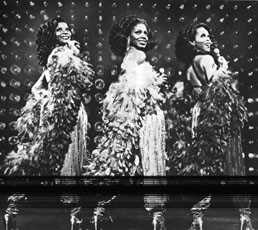 By 1972, Deena Jones and the Dreams have become the most successful girl group in the country. Deena has married Curtis, and C.C. is in love with Michelle. Jimmy has gone years without a hit. Curtis shows little interest in updating or revitalizing Jimmy's act because of his preoccupation with Deena and Jimmy's habit of sneaking funk numbers into his repertoire of pop-friendly songs. Effie is back in Chicago, a single mother to her daughter, Magic, struggling to get another break. Marty, who is now her manager, compels her to rebuild her confidence and give up her “diva behaviours.” Once she does, Effie is able to make a show business comeback. In contrast to Effie's struggling return to her musical career, Deena wants to stop singing and become an actress. Deena informs Curtis of her careers plans during a Vogue photo shoot, but Curtis refuses to let her go. Deena is not the only one chafing under Curtis's control: C.C. is enraged by Curtis's constant rearrangements of his songs, including an emotional ballad, entitled "One Night Only", which Curtis wants instead recorded to reflect the "new sound" he is inventing (disco).
Deena Jones and the Dreams and Jimmy Early perform at a National Democratic fundraiser, on a bill featuring such groups as The Five Tuxedos. While waiting backstage to go on, Jimmy finds himself in another argument with Lorrell as to the nature of their relationship and when, or if, Jimmy will tell his wife about their affair. Lorrell is in tears as Jimmy takes to the stage to perform "I Meant You No Harm", and turns to Deena for support. As Jimmy pleads to Lorrell through his music, Deena tries to help Lorrell successfully resolve her situation, and Michelle convinces the artistically frustrated C.C. to go find his sister and reconcile with her. Midway through "I Meant You No Harm", Jimmy falls apart and decides that he "can't sing any more sad songs." Desperate to keep his set going, Jimmy launches into a wild, improvised funk number, dropping his pants during the performance. An embarrassed Curtis fires Jimmy as soon as his set concludes. Lorrell ends her affair with Jimmy, as well. The heartbroken Jimmy fades into obscurity, refusing to "beg" for Curtis's help.
Marty arranges for C.C. to meet and reconcile with Effie at a recording studio. C.C. apologizes for his role in handicapping her career, and Effie records C.C.'s "One Night Only" in its original ballad format. "One Night Only" begins climbing the charts, causing an enraged Curtis not only to rush-release Deena and the Dreams' version, but to use massive amounts of payola to push Deena's version up the charts and Effie's version down. Effie, C.C., and Marty discover Curtis's scheme and confront him backstage at a Dreams’ concert, threatening legal action. As Curtis makes arrangements with Effie's lawyer to reverse his wrongdoings, Effie and Deena reconcile (and Deena learns that Effie's daughter Magic is Curtis's child). Realizing what kind of a man Curtis is, Deena finally finds the courage to leave him and live her own life. Effie's "One Night Only" becomes a number-one hit, as the Dreams break up so that Deena can pursue her movie career. For the final number of the Dreams' farewell concert, Effie rejoins the group on stage, and all four Dreams sing their signature song, "Dreamgirls" one last time before their breakup.
Musical Numbers
- I'm Looking for Something
- Goin' Downtown
- Takin' the Long Way Home
- Move (You're Steppin' on My Heart)
- Party, Party
- I Want You Baby
- Family
- Dreamgirls
- Press Conference
- Only the Beginning
- Heavy
- It's All Over
- And I Am Telling You I'm Not Going
- Love, Love You Baby
- Dreams' Medley
- I Am Changing
- One More Picture Please
- When I First Saw You
- Got to Be Good Times
- Ain't No Party
- I Meant You No Harm
- Quintette
- The Rap
- I Miss You Old Friend
- One Night Only
- I'm Somebody
- Faith in Myself
- Hard to Say Goodbye, My Love
Instrumentation:
Violin, cello, trumpet, trombone, French horn, woodwinds, keyboards, guitars, bass, drums, percussion.
Cast:
23 parts, 11 principals in a predominantly black cast.
- C. C. White and Curtis, actors who sing and dance.
- James Thunder Early, winning personality, strong nightclub singer who can move well.
- Lorrell, Deena, and Michelle, fashion-plate singers with excellent voices who act and dance.
- Effie, full-figured gospel singer with exceptional dramatic talent.
- Marty, Wayne, Dave, and Tiny Joe Dixon, supporting actors who sing and dance.
Total cast 35-50.
Scenes and Sets:
2 acts, 20 lightning-paced scenes,
mostly area sets that flow in and out of limbo and are very simple. A platform with a piano, a name in lights, a photographer's cyclorama, lights, and a camera suggest a more complete scene. Five gliding towers. The emphasis is on costumes and lights.
Act 1
Scene 1: The Apollo Theatre
Scene 2: On the Road
Scene 3: A Recording Studio
Scene 4: Limbo
Scene 5: A Hotel in St. Louis
Scene 6: Miami
Scene 7: Dressing Room in the Atlantic Hotel
Scene 8: Cleveland
Scene 9: A TV Studio
Scene 10: San Francisco
Scene 11: Las Vegas (backstage)
Scene 12: Las Vegas (on stage
Act II
Scene I: Las Vegas Hilton
Scene 2: Chicago Nightclub
Scene 3: Vogue Magazine Photo Call
Scene 4: National Democratic Fundraiser
Scene 5: A Chicago Recording Studio
Scene 6: Los Angeles
Scene 7: Chicago
Scene 8: New York
Period and Costume:
The early 60s to the early 70s. 18 sets (3 each) of stunning nightclub show gowns. Men's formal wear, men's pinstripe, casual, and regular suits, everyday sports clothes, evening wear, female jump-suits, photographer's smocks, men's hip casual wear, matching costume jackets for five male singers and three other groups, winter overcoats, men's hats. About 50 wigs, many with exotic hair styles.
Choreography:
Constant rhythm/rock movement, nightclub acts, jazz, disco, production numbers, rapid-paced overlapping scene changes.
Lighting and Special Effects:
Heavy and tight area lighting with dissolve-like changes as action shifts around the stage. Drop of patterned light bulbs. "The Dreams" name in 8-foot lighted letters, follow spots.
Note: Dreamgirls is fiction that closely matches the
history of Motown's The Supremes singing group, both in sound and in history
to the point when stardom was achieved. Even more, it tells the story
of a composite of black groups that reached public acclaim in the 60s.