COLETTE COLLAGE
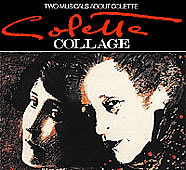
Music by Harvey Schmidt, book by Elinor Jones: lyrics by Tom Jones
Inspired by Earthly Paradise by Colette
Ellen Stewart Theatre, Off-Broadway 6 May, 1970 (101 perfs)
York Playhouse at the Church of Heavenly Rest (Off-Off Broadway)- Opened 31 March, 1983 -(17 perfs)
A fascinating portrait of the great French authoress by the major talents of the creators of The Fantastiks, Celebration and many other shows. Act one deals with Colette's youthful marriage to an exploitive older man, culminating in her break for independence. Act two shows her, in celebrated maturity, falling in love with a much younger man and their moving survival through doubts and a world war into a calm twilight.
The title is carefully chosen, not just for its alliteration but as some indication for the concept of the show: a collage, a colourful assembly of many elements arranged in an abstract pattern to create a unified work. Scenes shift in a wistful way. Time and place are telescoped here and there. There is no slavish adherence to plot progression or development from scene to scene. The form is free and contemplative. The performers often ruminate aloud or confront the audience directly.Synopsis
PART ONE - "Willy."
"Joy" is the opening song and sets the tone for the musical play. An 80-year-old woman at her writing desk expresses her joy, not only of being alive, but of indulging in memories of when she was a mere slip of a girl of 17. A group of shadowy figures accompany her in the song and turn the clock back singing "Let's peel this ancient face away" as the octogenarian is transformed into the young, vibrant teenager in long braids early in the century.
The place now is Saint-Sauveur, Colette's childhood home: a village a hundred miles southeast of Paris, an idyllic rural cottage, an arbor, a trellis, and a sophisticated visitor from Paris completes the picture. He is Henri Gautier-Villars, better known in his Parisian circles by his pen name, Willy. Twice her age, with top hat and cane and a distinguished moustache, Willy urges her to "Come To Life," to embrace the world and all its pleasures. This sophisticated author bewitches Colette, but her mother, Sido, warns her that she's too young, too naive and yet gives her headstrong daughter her blessing to marry this man of the world.
"A Simple Country Wedding" follows.
What was a desk in the opening sequence has become a bed in Paris. In his garret, cluttered with manuscripts, clippings, files and newspapers, as much an office as their living quarters, visitors come and go including an array of young men ghost writing Willy's columns as he urges them on with "Do It For Willy," as well as a bevy of young girls with whom he flirts and manages to seduce while Colette looks on from the sidelines. She can't help but comment on how successful he is at winning over anyone who crosses his path.
Colette seeks the advice of Jacques, Willy's secretary, who cautions her to remain the youngster she is, innocent and unsophisticated in order to hold on to Willy. If she becomes mature and sophisticated he warns her in song, "Willy Will Grow Cold," advising her to dress as the child she is and play the innocent.
Plagued by debts despite the stable of writers he has working for him, Willy seeks distraction with Colette. She entertains him with naughty little stories of her schooldays. He's enchanted and comes up with the idea of publishing her tales, urging her to enhance them with provocative details and a lot of slang. She becomes the new discovery in his "literary factory." We see her now at work reading passages from The Adventures of Claudine aloud to Willy. He urges her on with compliments and criticisms calling for a bit more spice here, a little hanky-panky there as the women's chorus joins her in "The Claudines."
Tossing off page after page, she spins out the naughty adventures of Claudine, a promiscuous 15-year old, but of course with Willy's by-line. It's a success. Twenty thousand copies! A second printing! A third! Willy parades Colette and an actress, Polaire, around Paris as the Claudine twins, causing a sensation, and Willy becomes the toast of the town. In an interview, he recounts the history of the Claudine phenomenon, the public demand for sequels, and concludes the interview joining Colette and the girls in the finale of the number, "The Claudines."
As she comments directly to the audience, Colette observes the success and longs to share some of the glory. She'd like to be acknowledged as the author of the tales. Out of the question counters Willy. They argue bitterly. She wants recognition for her work. In response to her demands, he offers her the exit. She contemplates her future singing "Why Can't I Walk Through That Door?"
Jacques, the secretary, reappears announcing he's found a job moonlighting in a vaudeville show. She begs him to take her along. "The Music Hall" number features Jacques and members of the ensemble. Backstage, in costume and applying make-up, Colette reassures herself that she's a good performer but Jacques is reluctant to agree, fearing she'll acquire a swelled head. Other acts are announced with placards on easels at the sides of the stage. Then Colette and Jacques come on in animal costumes to do their "Dog and Cat Duet" - she's "aristo-cat-ic" and he's "a bit dog-matic."
Backstage at the dressing table Colette reads a letter from home, from Sido. We see the cottage and the gardens at Saint-Sauveur again and Sido sings "I Miss You." She remains in the scene as Colette is visited backstage by an admirer, the Marquise de Belboeuf (nicknamed Missy), a notorious lesbian who comes on strong, and Colette is obviously entranced. Both dressed as dapper young men in vests, trousers and spats, they sing "La Vagabonde."
At the end of the number Willy walks in and pleads for her to return to continue the Claudine stories, offering 50% of the profits and co-authorship. Reluctantly she agrees and signs the contract.
Embraced by Sido when they are together at the funeral of Colette's father, she seeks comfort from her mother who advises her to break free of Willy. The scene shifts to Willy and Colette confronting each other. He reminds her she's no longer a youngster. She's now 30 and starting a new career on stage. She, in response, turns the tables on him showing him himself as old and pathetic and impotent.
She ends part one with a reprise of "Now I Must Walk Through That Door" unbowed, determined, invigorated, frightened. Now she can be, not Madame Willy; now she can be Colette. Just Colette.
PART TWO - "Maurice."
It's 1925. Colette has published some twenty books. We are at her villa in the south of France. Her desk, again, is heaped with manuscripts. An ensemble sings "Autumn Afternoon" and sets the mood for Colette to ruminate upon her young and handsome fantasy lover, Chéri, the subject of many of her stories. The song continues and Colette joins in. The fantasy memory explodes before our eyes in a barrage of flashbulbs as photographers and reporters invade her villa. She poses and plays the game of celebrity with bons mots and naughty comments about love and writing. One young man stands out among the crowd and she is drawn to him. Maurice. However, Maurice is not a reporter but simply a merchant.
Colette makes an announcement to the press that she is opening a beauty salon featuring a line of cosmetics particularly targeted at women of that "certain age." "Decorate The Human Face" follows, sung by Colette to "You ladies who are verging on your prime/And also those who've been there quite some time," offering ointments, creams, sprays, and emollients - a kind of singing commercial for her beauty products.
In the interview we discover Colette has a young daughter in school.
After the interview, Sido appears in the shadows and we hear a reprise of "I Miss You" in a kind of memory apparition. Her 13-year-old daughter comes in ending the reverie. They promise next time to do all the things they meant to do this time. With a kiss and a wry smile the youngster is gone.
The scene shifts to the visit of Maurice. They drink a toast to one another and he offers to take her to dinner at a waterfront café, but she declines because of the pile of work she has at her desk. Her secretary, Jacques, lets her know he moonlights, singing at the very bistro Maurice had suggested, and the scene shifts to the waterfront dive where Jacques is entertaining the small crowd with "Riviera Nights" on a tiny bandbox stage. He ends the song reaching out to Colette as they dance while the scene melts into a starlit background and Colette is in Maurice's arms as the ensemble joins in ending the song with a flourish.
As lights come up, we see Maurice asleep in her bed. She, in a dressing gown, looks upon him and then tries to send him away. He only smiles and she succumbs to his charms. In his undershorts, straw hat, and cane he performs "Ooh-La-La" for her and she joins in with her own interpretation snatching the hat and cane from the young man. They agree not to become serious or possessive of one another. They agree to consider their relationship nothing more than a fling, a diversion, a distraction, "Something for the Summer," nothing more than "a little sexual soufflé" as the lyric puts it. Projected in the background are images of Saint-Tropez in the 1920s. The ensemble joins in the song as the scene extends into "something for the winter" in Paris with images of the city in the '20s. In the sequence that follows, "Madame Colette" is honoured with a raft of citations and tributes from the King of Sweden to Belgium's Royal Academy. As she approaches a platform she is older and worn, and suddenly crumbles, clutching in pain at her leg as the lights fade.
Jacques is at her side but she refuses even an aspirin to ease the pain, determined to endure every feeling, even suffering.
Maurice and Colette face the discrepancy in their ages - she at 57, he at 34 - and what the future holds for them as he pleads with her in his song, "Be My Lady."
As Colette is re-reading old letters from her mother, a list of deaths and events through the 1930s into the German invasion of France, is listed. The Nazis have taken Maurice, who is Jewish, prisoner. "The Room Is Filled With You" is a memory song recalling their love from the past; the song is underlined with a faint military beat and the scene shifts as she is being interrogated by a German officer. She is back at her desk gathering jewels and cash to bribe the officer for Maurice's release through a French collaborator. Maurice appears. He sweeps her off her feet and bells ring out and the music swells at the war ends.
Colette, with a cane, helped by Maurice, approaches her bed as she sings "Growing Older." She turns to the audience to inform them "We're married, by the way, Maurice and I." Why had they waited so long? She explains "because we're busy. We never had a morning free … "
She complains of the cold. She seems to age before our eyes, growing weak, so fragile but still feisty enough to embrace all of her life and experience, rejecting nothing, discarding nothing, and the act ends with an exuberant reprise of "Joy," as we get a glimpse with photographs from the past: Colette as a youngster in braids, as Willy's bride, as a dancer, a Lesbian, in middle age, and Colette at the end still singing out: "Joy."
Musical Numbers
- Joy - Colette, Company
- Come To Life - Willy, Colette, Company
- A Simple Country Wedding - Company
- Do It For Willy - Willy, Ensemble
- Willy Will Grow Cold - Jacques
- Two Claudines - Colette, Willy, Company
- Why Can't I Walk Through That Door? - Colette
- The Music Hall - Jacques, Ensemble
- The Dog And Cat Duet - Colette, Jacques
- I Miss You - Sido
- La Vagabonde - Colette, Missy, Women
- Love Is Not A Sentiment Worthy Of Respect - Sido
- Now I Must Walk Through That Door - Colette, Ensemble
- Autumn Afternoon - Colette, Ensemble
- Decorate The Human Face - Colette
- Riviera Nights - Jacques, All
- Ooh-La-La - Maurice, Colette
- Something For The Summer - Maurice, Colette, All
- Madame Colette - Ensemble
- Be My Lady - Maurice
- The Room Is Filled With You - Colette, Women
- Growing Older - Colette
Cast:
3 men, 2 women, 6 chorus (may be expanded)
- COLETTE - Winsome, poetic, free, lovely. - Vocal Range: Soprano
- SIDO - Colette's beloved mother, a country wife
- WILLY - Rather large, proud, selfish. - Vocal Range: Baritone.
- JACQUES - A fey secretary and Colette's dearest confidant
- MAURICE - Gorgeous, satin-skinned, free, confident. - Vocal Range: Tenor
Roles for The ENSEMBLE:
- Missy, a chic lesbian;
- Captain, Colette's father;
- Colette de Jouvenal, Colette's neglected daughter;
- Cheri, Colette's sensual male character (who dances nude briefly);
- Reporters; Claudine lookalikes; wedding guests
Instrumentation:
2 pianos
Orchestra Size: - Small - (Standard Orchestrations by Larry Moore)
Alternative Instrumentation:
- Bass;
- Cello
- Harp
- Horn
- Percussion Bells, Cymbal, Vibe, Mark Tree, Chimes, Tympani, Sleigh Bells, Slide Whistle, SFX ;
- Reed 1 - Bb Clarinet, English Horn, Flute, Oboe, Piccolo
- Reed 2 - Bass Clarinet, Bb Clarinet, Flute, Tenor Saxophone
- Trumpet
- Viola
- Violin 1 & 2